Introduction
IBIS provides the possibility for a customer to retrieve Call Detail Records (CDRs) via FTP. This page will cover the format of this file, as well as the operational characteristics.
Access to the CDR Files
CDR files can be accessed via FTP. Once the CDR feed has been set up, the IBIS billing admin receives the URL of an FTP site, along with a username and password to log in there. CDR files are placed in the root directory of this FTP account. There is also an archive directory. This directory can be used to archive CDR files after they have been retrieved. CDR files are kept in the archive directory for at least one year, after which they may be removed.
Production of CDR Files
CDR files are created at set intervals. The frequency is configured in IBIS on the Customer Details screen, and can be set to Hourly, Daily or Monthly.
After each interval (hour, day or month), a CDR file is generated, even in case there are no CDRs. This can be used as a heartbeat mechanism to verify that the CDR feed is operating OK.
CDR files have the following naming pattern:

In the filename pattern, the following placeholders are used:
- V.V: version number of the export format (currently 1.0).
- YYYY: year of the file
- MM: month of the file
- DD: day of the file
- HH: hour of the file
Monthly CDR files
Every CDR feed (also the ones configured for daily or hourly files) get a monthly CDR file. The monthly CDR file is generated during the End Of Month process, and includes all the CDRs that are invoiced for that billing period.
Daily and Hourly CDR files
In case of daily and hourly files, the CDRs are written to the file as soon as they get rated. This has some implications:
- The date and hour indicated in the filename indicate the day and hour in which the CDR was rated, not to be confused with the day or time when the call was made. A file for a specific day or hour may very well contain CDRs with timestamps in an earlier day or hour, depending on how long it took for the CDR to propagate from its source to the IBIS, and the time it may have spent in the error list before it eventually got rated.
- As soon as the first CDR for a specific interval arrives, he daily or hourly file is created with a .work extention. This extension indicates work in progress: IBIS may append new CDRs to the file as they arrive. Once the interval is closed (at the end of the hour or day), the file is renamed to .csv. You are free to use the .work files, but they may still be written to, so you may find the files locked when you try to download them. We recommend waiting for the file to be completed and renamed to .csv.
- Every CDR feed includes a monthly file. You can choose to ignore the monthly file as all the CDRs in this file have already been provided in the hourly or daily files. You can also use it to verify that you have successfully retrieved all CDRs, or to update your CDRs with the latest price (see next point).
- Daily and hourly files get populated as soon as a CDR gets rated. It is possible that CDRs need to be re-rated at some later stage, for example if the card was activated on the wrong price plan. When CDRs get reprocessed, they may get a different price, but they will not be written to the daily or hourly files a second time. The monthly file that is provided at the end of the month will have the latest price for these CDRs.
File Format
The CDR files are in text format, with one CDR per line. Every line is ended with a Windows <CR><LF> combination. The first line is a header, providing the column names for the data lines that follow.
Elements in the file are separated by a comma.
There is no trailer record.
Manual file handling
When manually handling a .csv file, the file usually opens in Microsoft Excel, which has the habit of interpreting all values that seem to represent numbers. This causes Excel to interpret IMSI, ICCID and MSISDN values as numbers, but they are usually too long to fit in Excel’s number format accurately, so they will get rounded. This is not an error in the CDR file. Opening the file in a text editor will reveal the right information.
There are several workarounds for this issue in Excel; we suggest to read the discussions on various internet fora to find the one that is most suitable.
Partial CDRs
Depending on the source of the CDR, it is possible that the CDR files contain partial CDRs. Partial CDRs break down a single call or data session into multiple CDRs. In case of Inmarsat I4 services, this happens when the session is bigger than 2MB or lasts longer than 12 hours.
CDR Elements
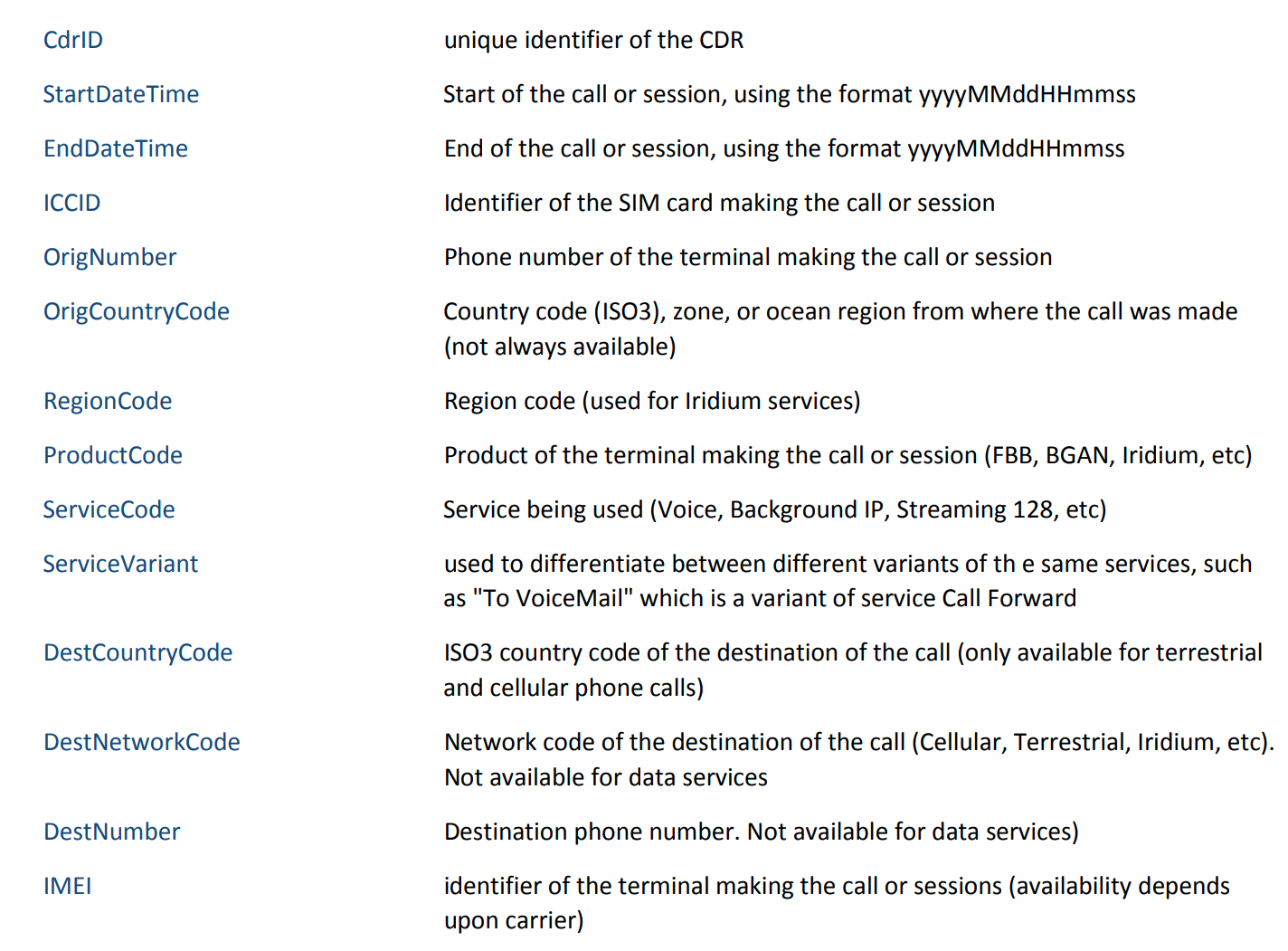
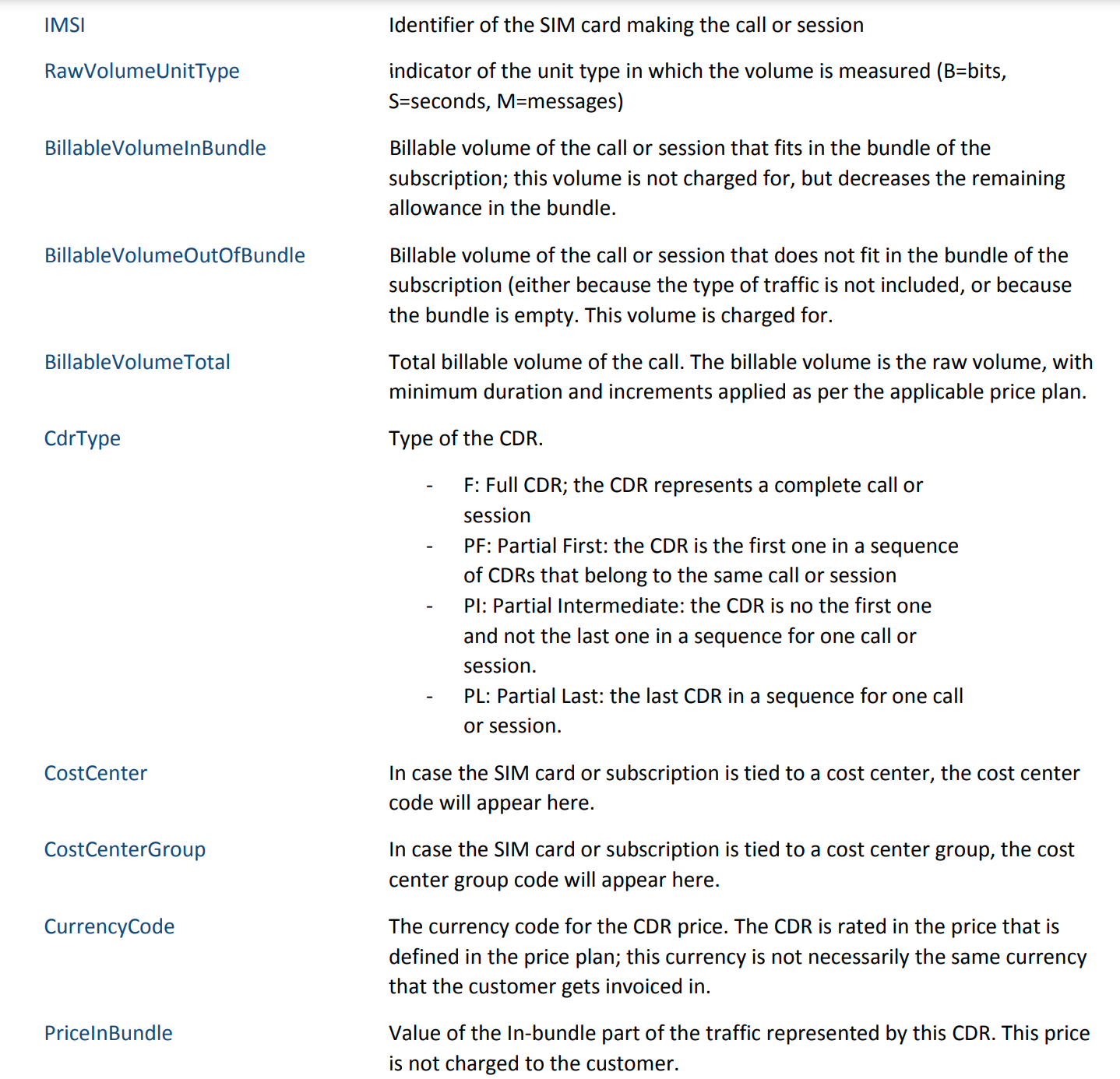
All CDR feeds (hourly, daily and monthly) include the same fields: