
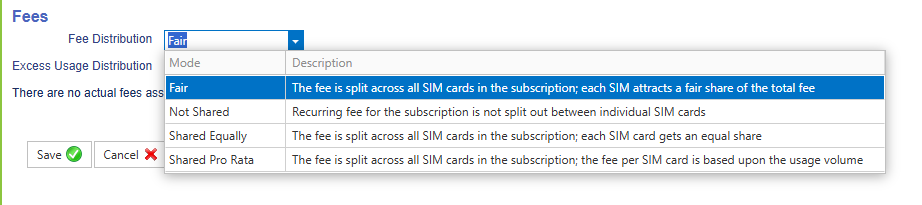
Fair distribution of the subscription fee
The fair distribution mode is intended to distribute the subscription fee and allowance of a pooled subscription (static subscription) in a fair way across the SIM cards that participate in the subscription. Each SIM card user that uses a pooled subscription with a total of N cards gets the guarantee that the card will never get charged more than 1/Nth of the subscription fee as long as he does not use more than 1/Nth of the allowance. If he uses less and others use more, he will be charged less.
The total subscription fee is split up in two parts: the part that represents the used allowance, and the part that represents the unused allowance.
The “unused” part is distributed evenly across all SIM cards that were member of the subscription during the month.
The “used” part is allocated as follows: Based upon the airtime usage pattern of all SIMS in the subscription, a “fair share” threshold is calculated. The “used” part of the subscription fee is allocated to the SIM cards pro rata to their individual usage up to the “fair share” threshold. Cards that have usage beyond the fair share will attract an excessive usage fee.
Fair distribution of excess usage
If the total airtime usage of the pool stays below the pool’s allowance, there is no excess usage, so there will not be any charges of this type. If the combined airtime usage of the cards goes above the pool’s allowance, there is excessive use. The fair distribution mechanism avoids that one SIM card consumes the entire pool’s allowance at the beginning of the month, while a second SIM card would end up with excess use charges if it generated only a modest amount of airtime traffic later that month.
The fair distribution model uses the “fair share” threshold that was also used when distributing the subscription fee. All usage below this threshold is regarded as in-bundle traffic, covered by the subscription fee. All usage of the SIM card above this threshold is regarded as excess usage and charged to the SIM card as excess use.
Non-bundled traffic
Airtime Traffic for services that are not included in the subscription’s allowance (e.i. Streaming, voice to satellite networks, etc) is not part of any distribution model, and is always charged as non-bundled traffic to the SIM card that generated it.
Example 1: No usage in bundle
Suppose a subscription with 10 SIM cards and a monthly 500 MB allowance for background-IP and a monthly subscription fee of $3000.
In a given month, none of the 10 SIM cards generated any traffic. This means that 100% of the subscription fee falls in the “unused” category, and is distributed across all of the SIM cards. Consequently, each SIM card attracts a charge of $300.
Example 2: Some usage within allowance
Suppose the same subscription (10 cards, 500MB allowance, $3000 fee).
In another month, SIM1 cards generated 100 MB of airtime, and SIM2 generated 300 MB.
The total airtime for the subscription in this month is 400 MB, so that is well within the monthly allowance. 400/500th of the subscription fee now falls into the “used” category, and 100/500 in the “unused” category.
The “unused” charge is 100/500th * $3000 = $600, and is distributed across all SIM cards evenly. Each SIM card is charged $60. The “used” charge is 400/500th * $3000 = $2400.
Since the allowance of the pool was not depleted in this month, the “fair share” threshold is set to 300; all traffic is treated as in-bundle.
Now:
SIM1 attracts 100/400 * $2400 = $600 on top of its $60 share in the “unused” part of the fee.
SIM2 attracts 300/400 * $2400 = $1800 on top of its $60 share in the “unused” part of the fee.
So, the total charges for the 10 SIM cards are $1860, $660, $60 $60 $60 $60 $60 $60 $60 $60, adding up to a total of $3000.
Example 3: More usage and allowance depleted
Suppose the same subscription (10 cards, 500MB allowance, $3000 fee).
In this example, SIM1 uses 50 MB, SIM2 uses 150 MB, SIM3 uses 700 MB of data.
The total airtime for the subscription in this month is 900MB, so all allowance is used, and 400 MB of data will be charged as excess usage.
The “unused” part of the allowance is zero, so SIMs 3-10 will not get charged at all.
The “fair share” of the allowance is now calculated as 300 MB. All usage up to 300 MB is treated as in-bundle, and used as the basis to distribute the subscription fee. Consequently:
SIM1 attracts 50 / 500 * $3000 = $300 as subscription fee.
SIM2 attracts 150 / 500 * $3000 = $900 as subscription fee.
SIM3 attracts 300 / 500 * $3000 = $1800 as subscription fee.
On top of that, SIM3 attracts (700 – 300) / 400 = 100% of the excess usage charges.
Pro-rata distribution of the subscription fee
The fee is split across all SIMs in the subscription; the fee per SIM is based upon the usage volume
Example POOL has a fee of $450 per month. The fee is represents the USD allowance per month, all services included.
Total usage of Sims combined in this POOL = $465.54 ($15.54 more than the $450 allowance/ bundle= excessive usage)
Mobile 1
Total usage value $169.32 (in excess of bundle $10.24)
$169.32/$465.54 = 36.37%
Fee: $163.37 (36.37 % van $450)
Airtime in excess of bundle: $10.24
Mobile 2
Total usage value $58.08 (in excess bundle $5.30)
$58.08/$465.54 = 12.47%
Fee= $56.14 (12.47% van $450)
Airtime in excess of bundle: $5.30
IMPORTANT NOTE on fee and usage distribution
The distribution of subscription fees and excess usage charges happens during End of Month processing. It is just a way to allocate the costs to individual SIM cards. The distribution does not re-process call details. The consequence is that it is quite possible that a SIM card that generated a lot of traffic at the beginning of the month will have CDRs that do not show excess usage (at that time of the month, the allowance was not yet depleted). Yet, on the invoice the card does get excess usage charges because eventually the allowance got depleted by some other SIM cards.